Dover Whitecliff
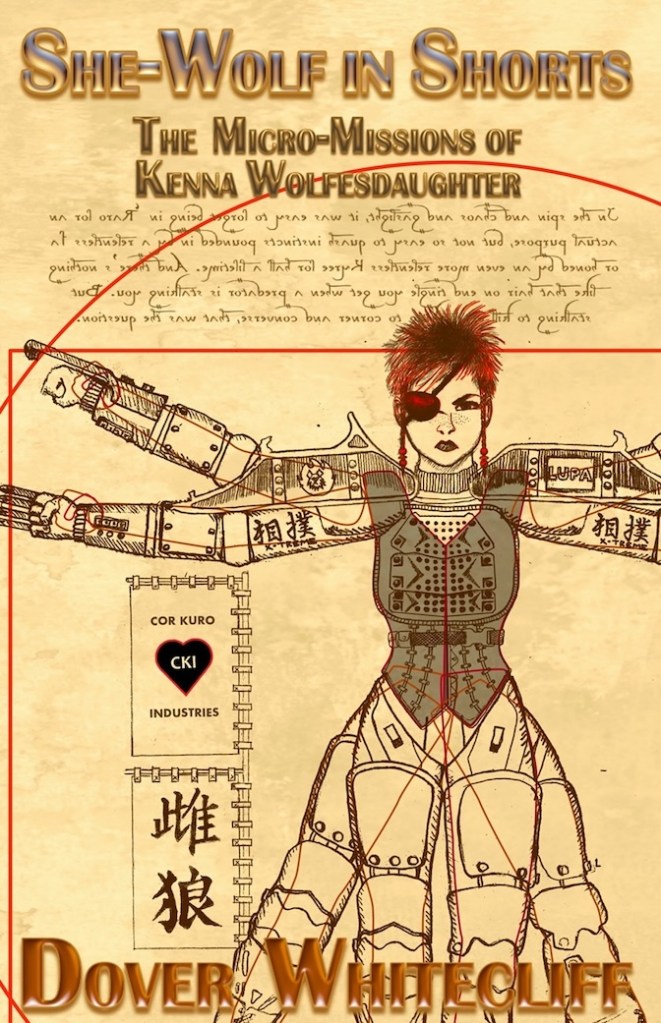
I’m a bit of a magpie when it comes to learning. I pick up things from all over the place. Nothing is wasted. So, how I write, be it method, process, or daydream, usually comes from a mashup of things I’ve picked up here and there that most people wouldn’t connect to authoring at all. In this post, I’ll show you two concepts I learned from kabuki and how they shaped She-Wolf in Shorts.
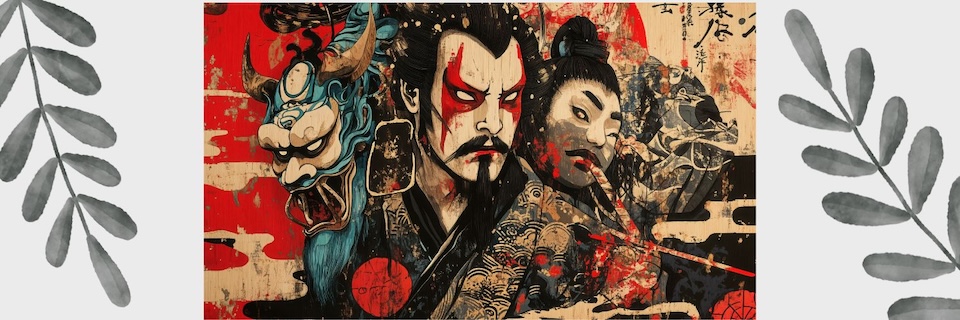
Why Kabuki?
I was born in Japan and raised in Hawaii at a time when cable television and streaming didn’t exist. Because the reception was so bad on the windward side of the island, even with the huge antenna on our roof, we had mostly snow-static with the occasional flash of something tantalizing on every single station except two: PBS and KIKU, the Japanese channel.
Along with anime and modern dramas, KIKU broadcast traditional Japanese arts. That was my first introduction to kabuki, a classical theater tradition in Japan. Think of it as seeing Hamlet at the Globe or that Scottish play at a renaissance faire. Simple sets, classic plots, and flowery language punctuated with some epic fight scenes.
I’d watch the clips they showed on KIKU (kabuki performances were a little long for television so you mostly got the “good parts” summary of a popular play) entranced. I was fascinated by the cool costumes and the vibrant makeup, and the way they’d stomp and pose before critical moments.
The first connection that hit me as a kid was how much some of the characters reminded me of anime. All those masks, poses, and fierce gazes in Voltron, Kikaida, and Ultraman come straight from Kabuki. But as I grew into my storyteller’s shoes, I began to see more gold nuggets that could help me improve my writing. Without them, I wouldn’t have completed She-Wolf in Shorts, or fleshed out my favorite character: Kenna Wolfesdaughter, the superspy with the clockwork eye.
Who are those guys at the back of the stage?
In high school, I saw my first kabuki play in the theater. Unlike a lot of western theatrical performances where the scene and prop changes happen off stage or after the curtain falls, you can see everything in kabuki. On a small television screen, it doesn’t really hit you, but in the theater, especially for a teenager trying to absorb it all, it was an eye opener. Everything from costume changes, set changes, and special effects (like flying above the stage) is handled by the stagehands, called koken.
Koken dress in black head to toe. They kneel in the darker area at the back of the stage, heads down, and completely still until they’re needed, zip into action, and then return to their spots. They’re so skilled at their jobs that you stop noticing they’re on stage, almost as if they were prop ninja (in Japan, ninjas is not a word – one ninja, two ninja). Without them, the performance would never happen.
Seeing that showed me that I’m the koken for my books. I’m not the protagonist, even in an autobiography. It’s not my job to disarm the bombs or fight the dragons. I’d be in the hospital on page one if I tried. Nope. My job is to work unobtrusively with the characters and the scenery so that the readers see what I need them to see, which brings me to…
Never make a reader say “Huh?”
The instant a reader drops out of my story because of a mistake I made, I’ve failed. Even though an editor is paid to edit, the quality starts with me. My baby, my responsibility. Spelling errors. Grammar errors. Continuity errors. They’re all the equivalent of the koken bringing up a prop, tripping, and face planting on the way to the front of the stage. Suddenly, everybody knows I’m there.
For She-Wolf in Shorts, I found serious continuity problems when I did my read through. I wrote the original stories for various anthologies over three years. I had also written them out of chronological order. To throw a monkey in the wrench, I overwrote most of them and had to cut scenes to meet the word counts. As a result, when I put together the collection, this time in order, even I was saying “Huh?”
I had Kenna going into one hotel and leaving a different one and fudged the times and dates of a couple of stories. I also left out clues for the later installments, since my head remembered writing the clue into a previous story, but not that the clue was in a scene I had to cut during editing. I would have face-planted on the way to change the scenery and ruined the kabuki performance if I’d been a koken.
Cast Shadows a Mile Long
Koken and the actors that play lead roles have a symbiotic relationship. An actor on one side of the stage can draw attention away from the koken completing a set or costume change on the other side. The fierce gaze, called a mie pose, pulls every eye toward that actor. It’s one of the things people go to see.
Kenna started as a straight up James Bond style superspy in my head. Cover persona as an exo-suit fighter, sneaking into the back offices during intermission, grabbing secrets, taking out targets, sneaking out.
Yeah. No. Kenna is a premier exo-suit fighter. Nowhere to hide from autograph hounds. She has burn-scars and skin-grafts all down her left arm from being in an airship crash when she was ten or so. They’re an important plot point later so I couldn’t get rid of them. Either the scars would be noticed, or she’d have to wear long sleeves in all weather and still stick out like a sore thumb. Neither are great qualities for someone in the intelligence business. Love me some James Bond, but how can you get anything done stealthily if everybody knows your name, number, and favorite cocktail?
Kabuki to the rescue. My what if hamster (he runs on a wheel in my head, usually at three in the morning), wondered what if Kenna isn’t the actual superspy? What if she casts the shadows herself? She could be like the kabuki actor doing the mie pose and pulling attention away from the spy stuff going on over there in the corner.
Enter the role of Shadowcaster. I covered the scars with a full sleeve she-wolf tattoo, left shoulder to fingertips. I had had her learn the hard way in the first story that attitude and swagger are everything, because they keep your team from getting caught and killed. It also puts pressure on not to break cover…if she does there’s nowhere to hide.
Without having seen kabuki in the theater, I doubt I would have come up with that concept or had so much fun writing Kenna’s micro missions.
If you’d like to learn more about kabuki, you can’t go wrong with Kabuki. Sing. Dance. Act. on Netflix.
You can also check out my website: www.doverwhitecliff.com if you’d like to see the other stories I’ve painted outside the lines.
 Women Writing Other Worlds